SQL Language Contract
This reference describes the implemented dialect and its composition rules. Start with tested SQL examples for fixture-backed statements, or the project overview for a few demanding examples. “Producer” below means the part of the engine that yields candidate rows: a scan, join or correlated query.
Performance: some advanced queries are very slow right now.
Joins, correlated subqueries, grouping, sorting and duplicate elimination can walk the same relationships repeatedly. For demanding work, it is often faster to filter/project into TEMP tables, index the useful intermediate columns, and run the next query against that smaller result. The tested seven-step sales pipeline took 425.88 seconds PAL, compared with 2,300.2 seconds for the original grouped join—about 5.4× faster, including its intermediate table and index builds. These are measurements of this fixture, not a guarantee for every query.
Types and supported statements
Canonical scalar types are BOOLEAN, I8, I16, I32, I64, FIXED8_8, five-byte
Commodore FLOAT, CHAR(n), TEXT, BLOB, and named ENUM8 or ENUM16 types.
The complete target dialect includes CREATE/DROP TYPE, TABLE and INDEX;
INSERT/UPDATE/DELETE; SELECT with INNER/LEFT/CROSS joins, WHERE, GROUP BY, ORDER BY,
DISTINCT, LIMIT/OFFSET; aggregates; and scalar, IN and EXISTS correlated subqueries.
HAVING is intentionally unsupported.
Unhinted table sources scan deterministically. A source may use USING INDEX index_name; an incompatible hint is an error. ReuSQL64 never creates cost-based or
stored execution plans.
Inspect the database with SHOW
Catalog and capacity introspection uses bounded SHOW statements through rsql_exec():
SHOW DATABASE;
SHOW TABLES;
SHOW COLUMNS FROM customer;
SHOW INDEXES;
SHOW TYPES;
SHOW MEMBERS FROM state;
SHOW DATABASE returns one RsqlDatabaseInfo. The remaining statements return the
corresponding records declared in rsql_inspect.h; callers page them with the start,
capacity, and returned fields of RsqlExecRequest.output.inspect. Only visible
schema objects are reported.
Choose an explicit index
CREATE INDEX index_name ON table_name (column [, ...]) creates a persistent
single-column or compound index over fixed-width columns. Index names are global.
TEXT/BLOB keys, duplicate names, a missing index, and using an index owned by another
table are rejected.
The implemented hint form is:
SELECT projection [, ...]
FROM table_name USING INDEX index_name
[WHERE expression]
The index supplies deterministic candidate row IDs; the complete WHERE expression is still checked against each current row. Aggregate SELECT and GROUP BY consume the same explicitly named leaf-chain producer.
Independent indexes for three sources
A direct three-output-source join may name an access path independently for each source:
SELECT A.ID, B.ID, C.ID
FROM A USING INDEX IA
JOIN B USING INDEX IB ON B.AID=A.ID
JOIN C USING INDEX IC ON C.BID=B.ID;
Any subset of the three hints is legal. Each name is validated against its source table
and its persisted leaf stream drives only that nested-loop level. The physical leaf
order is not a substitute for ORDER BY.
With a middle or inner hint, the second ON program is bounded to six predicates because two otherwise-idle private-predicate name fields retain the hints through binding.
Join tables
INNER, LEFT and CROSS joins
Two-source joins support JOIN/INNER JOIN, LEFT [OUTER] JOIN, and CROSS JOIN.
Tables may use an explicit AS alias, and qualified references use alias.column:
SELECT C.NAME, O.ID
FROM CUSTOMERS AS C
LEFT JOIN ORDERS AS O ON C.ID = O.CUSTOMER_ID
WHERE O.TOTAL >= 10 OR O.ID IS NULL
Execution is a deterministic outer-then-inner nested-loop scan. ON and WHERE each use the bounded postfix Boolean evaluator and preserve three-valued NULL semantics; WHERE is applied after LEFT JOIN NULL extension. Column-to-column comparisons support compatible signed integers (including different widths), CHAR, BOOLEAN, FLOAT, FIXED8_8, and identical named enum types.
Joined TEXT and BLOB projections retain normal stable-handle streaming.
Composition and source limits
The fully composed join path is bounded to two sources, eight result columns, eight predicates, and 24 Boolean opcodes. A three-output-source INNER/LEFT/CROSS scan path is implemented for fixed and streamed projections and predicates. Its second ON and final WHERE may reference any available source and use named enum members.
COUNT/SUM/AVG/MIN/MAX may consume numeric columns from any of the three sources, fixed-width keys from any source may be grouped, and LIMIT/OFFSET applies to raw or grouped output. Three-source LEFT, ORDER BY, DISTINCT, TEXT/BLOB and scalar projection, plus independent source-local index hints are supported. `CREATE [TEMP] TABLE ...
AS SELECTmaterializes this form too, including fixed columns, raw TEXT/BLOB, streamed TEXT scalars, and grouped aggregates. A fourth JOIN is a syntax error. Qualified reference text is at most 15 characters, so long table names should use a shortAS`
alias.
Ordering and grouping joined results
A joined result may use up to two qualified fixed-width source columns or positive ordinals selecting fixed scalar projections in ORDER BY, including ASC/DESC and LEFT-null placement; LIMIT/OFFSET composes with that ordered stream. Joined DISTINCT compares complete fixed raw or scalar projected tuples across prior joined pairs. LENGTH, substring, concatenation, and string-literal projections are compared as virtual values without materialization.
Streamed TEXT/BLOB ON and WHERE predicates compose with joined ORDER BY and exact DISTINCT rescans; each pending predicate is evaluated in the predicate sidecar before the joined producer resumes. Joined aggregates accept fixed outer or inner GROUP BY keys, including compound and LEFT-null keys, and the same COUNT/SUM/AVG/MIN/MAX integer/FIXED8_8/FLOAT set as ordinary scans. Joined grouped results support named group-key or aggregate-ordinal ORDER BY, exact fixed projected-tuple DISTINCT, and LIMIT/OFFSET.
Ordinary two-source scan joins and the direct three-output-source form accept an independent named index after each source; each name is validated against its owning table and drives that source's leaf iterator. Correlated-subquery and aggregate join producers reject index hints explicitly. A hint is an access path, not implied SQL ordering.
Correlated subqueries
Scalar, IN and EXISTS forms
One bounded subquery may appear as an outer WHERE term and may be combined with the outer Boolean program:
SELECT C.ID FROM CUSTOMERS AS C
WHERE EXISTS (
  SELECT 1 FROM ORDERS AS O WHERE O.CUSTOMER_ID = C.ID
);

SELECT C.ID FROM CUSTOMERS AS C
WHERE C.ID IN (
  SELECT O.CUSTOMER_ID FROM ORDERS AS O WHERE O.TOTAL >= 0
);

SELECT C.ID FROM CUSTOMERS AS C
WHERE C.ID = (
  SELECT O.CUSTOMER_ID FROM ORDERS AS O WHERE O.ID = 10
);
Scalar, IN/NOT IN, and EXISTS/NOT EXISTS preserve SQL UNKNOWN behavior. A scalar
subquery returning no rows supplies NULL; more than one row returns
RSQL_ERR_SUBQUERY_ROWS. Inner WHERE supports its own parentheses, NOT, AND, OR,
comparisons, NULL tests, CHAR patterns, compatible column references, FLOAT/FIXED8_8
values, and named enum literals.
Execution is a deterministic correlated nested rescan with no plan or materialized result.
Correlate against a joined pair
The outer producer may also be an ordinary two-source join:
SELECT O.ID
FROM CUSTOMERS AS C JOIN ORDERS AS O ON C.ID = O.CUSTOMER_ID
WHERE EXISTS (
  SELECT 1 FROM ORDERS AS X
  WHERE X.ID = O.ID AND X.CUSTOMER_ID = C.ID
)
ORDER BY O.ID DESC LIMIT 1;
The third-source inner program may correlate to either joined row. Scalar, IN/NOT IN, and EXISTS/NOT EXISTS retain their ordinary cardinality and NULL rules. The output identity remains the outer/inner joined pair, so fixed ORDER BY, projected-tuple DISTINCT, LIMIT, and OFFSET continue to use the joined bounded-rescan path.
Depth, row buffers and result shaping
The ordinary bound is one correlated subquery, one fixed-width selected value, eight inner predicates, and 24 inner Boolean opcodes. A correlated EXISTS may contain one additional scalar, IN/NOT IN, or EXISTS/NOT EXISTS subquery over a third table. Its innermost predicate program may correlate to either earlier row, preserves NULL/UNKNOWN and scalar-cardinality rules, and feeds ordinary scan, ungrouped aggregate, or grouped aggregate cursors.
A further nesting level and explicit index scans within nested subqueries are not supported. A joined outer producer may feed either a scan or aggregate/group cursor; a single-table correlated outer producer may also feed either cursor mode. Named enum literals resolve against the exact outer, joined, or third-source enum column in a combined predicate.
LIMIT/OFFSET is supported on the outer result. ORDER BY accepts up to two fixed outer-source columns or projection ordinals, including fixed LENGTH, substring, and source-to-source concatenation scalar values. It supports ASC/DESC and composes with LIMIT/OFFSET by restarting the correlated producer.
DISTINCT compares the complete fixed raw or scalar outer projection against prior matching outer rows and composes with ORDER and pagination. Quoted literals are stored in a separate packed SELECT pool, so correlated scalar shaping composes with a live inner predicate program.
Nested predicates feeding aggregates
Depth-2 aggregate examples include:
SELECT COUNT(*), SUM(A.ID)
FROM A
WHERE EXISTS (
  SELECT 1 FROM B
  WHERE B.AID=A.ID
    AND B.V IN (SELECT C.V FROM C WHERE C.BID=B.ID)
);

SELECT A.ID, COUNT(*)
FROM A
WHERE EXISTS (
  SELECT 1 FROM B
  WHERE B.AID=A.ID
    AND EXISTS (SELECT 1 FROM C WHERE C.BID=B.ID)
)
GROUP BY A.ID ORDER BY A.ID;
NULL, text comparison and numeric conversion
NULL follows three-valued SQL behavior. Text defaults to folded PETSCII comparison with
COLLATE BINARY available. FLOAT columns accept signed integer, decimal, and
scientific-notation numeric literals; BASIC ROM FIN produces the canonical five-byte
value.
Other numeric conversions allow only lossless integer widening unless an explicit CAST is present.
Named enumerations
Named enumerations are created with CREATE TYPE name AS ENUM8 (...) or ENUM16 (...).
Members receive zero-based sequential values unless an explicit unsigned value follows
=. A table column names the enum type directly, and INSERT, WHERE, and fixed-record
UPDATE accept qualified member literals such as MOOD.HAPPY.
The qualifier must identify the exact enum catalog ID bound to the column; wrong enum types, missing members, and values outside the enum's unsigned width are errors. Cursor results retain the physical ENUM8/ENUM16 tag and catalog ID.
Grouping and aggregates
Supported inputs and NULL rules
The implemented aggregate subset is COUNT(*), COUNT(column), SUM, AVG, MIN,
and MAX over signed I8/I16/I32/I64, signed Q8.8 FIXED8_8, and FLOAT columns, with zero
or more fixed-width GROUP BY keys. An ordinary single-table producer also accepts
TEXT/BLOB group keys and compound mixtures; it compares logical payloads by streaming
REU pages, folds TEXT case, retains binary BLOB identity, and treats all NULLs as one
group.
COUNT returns non-NULL I64; the other aggregates return NULL for an empty input or NULL-only group.
Integer, FLOAT and Q8.8 results
Aggregate numeric results over integer columns are I64 and integer AVG truncates toward zero. FLOAT SUM/AVG/MIN/MAX return canonical five-byte FLOAT values using BASIC ROM arithmetic. FIXED8_8 SUM/AVG/MIN/MAX retain the two-byte FIXED8_8 result type.
Their accumulator stores signed raw Q8.8 units in I64; AVG divides that raw sum by the
non-NULL count and truncates toward zero to the nearest 1/256. SUM outside the two-byte
signed Q8.8 result range reports RSQL_ERR_NUMERIC_OVERFLOW when the result column is
accessed or streamed, rather than wrapping.
Aggregate ordering and exact DISTINCT
Without ordering, group results follow first physical key occurrence. Aggregate/grouped ORDER BY accepts up to two named fixed group keys or positive projection ordinals selecting an aggregate result; integer, FIXED8_8, and FLOAT aggregate values, ASC/DESC, SQL NULL placement, LIMIT, and OFFSET are supported. Aggregate function text is not repeated in ORDER BY: select it and use its ordinal.
DISTINCT is valid for ungrouped and grouped aggregate queries. The one-row ungrouped case and grouped projections containing every group key are proven unique at bind time. If a grouped projection omits a group key, the engine compares the complete projected tuple against prior groups and removes duplicates exactly, including NULL and aggregate values.
Joined and correlated aggregate input
The same rules, including streamed TEXT/BLOB group keys and group-key ORDER BY, apply after INNER, LEFT, or CROSS join production and after a correlated single-table producer. ON and WHERE are evaluated before accumulation; COUNT(*) includes a LEFT-null extension, COUNT(inner_column) does not, and non-COUNT aggregates return NULL for a NULL-only joined group.
The joined WHERE may include one correlated scalar, IN/NOT IN, or EXISTS/NOT EXISTS subquery over a third table; its Boolean program may reference either joined source, and only qualifying pairs enter the aggregate or group.
Aggregates across three output sources
The direct three-output-source INNER/LEFT/CROSS producer uses the same aggregate types and NULL rules for fixed-width columns. Group keys and aggregate inputs may come from any source, nonaggregate projections must be group keys, and ungrouped aggregate output is one row. Fixed source/group keys and aggregate ordinals support bounded ORDER BY; DISTINCT compares complete raw or grouped projected tuples.
Raw TEXT/BLOB projection streams through the value API. CHAR/literal/TEXT LENGTH,
SUBSTR/SUBSTRING, CONCAT, and || projections are also live; positive projection
ordinals order their computed values and DISTINCT compares them exactly by replaying
triple identities and streaming TEXT payload chunks from REU. Raw TEXT/BLOB keys
participate in ORDER BY and exact DISTINCT, with case-folded TEXT and bytewise BLOB
comparison.
WHERE may stream TEXT/BLOB literal comparisons and TEXT LIKE from any of the three sources. Independent explicit per-source access paths and wide CTAS are live.
String expressions
LENGTH, substring and concatenation
SELECT projection expressions support these bounded string forms:
LENGTH(value)
SUBSTR(value, one_based_start [, maximum_length])
SUBSTRING(value, one_based_start [, maximum_length])
CONCAT(left, right)
left || right
Operands may be CHAR columns, TEXT columns in the bounded forms described below, or
quoted string literals. CHAR LENGTH ignores physical trailing padding and returns I16.
CHAR substring and concatenation return a cursor CHAR value whose reported length is the
logical payload; rsql_value_read() supports slices across a concatenation boundary.
Binary concatenation accepts two columns, one column plus one literal in either order, or two literals. SQL NULL propagates through all operations.
Streaming TEXT without a combined buffer
LENGTH(TEXT) returns I32. SUBSTR/SUBSTRING over TEXT reports a TEXT value and
translates each rsql_value_read() slice directly into the stable REU blob range; it
never materializes the full payload in C64 RAM. A start of zero is a syntax error, an
omitted length means through the logical end, and zero or an out-of-range span returns
an empty non-NULL string.
Any concatenation with a TEXT operand returns TEXT. TEXT||literal, literal||TEXT,
TEXT||TEXT, TEXT||CHAR, CHAR||TEXT, and their CONCAT spellings stream the two
logical pieces in order. TEXT handles are validated one at a time and fixed CHAR
operands use their trimmed logical length; the payload is never materialized in C64 RAM.
Scalar projections compose with ordinary scans, explicit indexes, two-source joins, correlated subqueries, direct three-source joins, and LIMIT/OFFSET. Fixed and streamed TEXT scalar results compose with ORDER BY and DISTINCT on ordinary, joined, correlated, and direct three-source scans.
String expressions in grouped results
Aggregate/grouped cursors may also project LENGTH, substring, concatenation, and
string literals when every referenced column is a GROUP BY key; an ungrouped aggregate
may project literal-only scalars. These forms are verified for ordinary, two-source,
direct three-source, and CTAS producers. Composed aggregate scalars participate in
positive-ordinal ORDER BY and exact DISTINCT for ordinary, joined, correlated, and
direct three-source aggregate/group cursors.
Their logical bytes are recomputed from each group's representative row (or representative joined pair/triple) and compared in bounded chunks. No grouped result is materialized for comparison.
ORDER BY, DISTINCT and pagination
Keys, ordinals and NULL placement
Ordinary, joined, and correlated outer scans support ORDER BY, DISTINCT, LIMIT,
and OFFSET over fixed values and raw streamed TEXT/BLOB columns. ORDER BY accepts one
or more source columns or positive SELECT-list ordinals with independent ASC/DESC
directions. An ordinal must be in the explicit projection list; zero and out-of-range
ordinals are rejected.
ASC places NULL before non-NULL and DESC places NULL after non-NULL. Signed integers compare numerically across their physical widths; CHAR uses folded, trailing-space-insensitive comparison; BOOLEAN, identical named enums, FIXED8_8, and FLOAT retain their native ordering. TEXT compares case-insensitively and BLOB compares binary bytes; both stream across linked REU pages.
Duplicate ORDER keys are rejected.
Exact projected-value identity
DISTINCT compares the complete projected tuple using SQL value identity, including one
shared NULL value and streamed raw TEXT/BLOB columns. LENGTH, substring, and
concatenation results are evaluated before comparison, so their computed values rather
than source columns determine duplicates. It can be combined with WHERE, ORDER BY,
LIMIT, and OFFSET.
Streamed comparisons and LIKE are reevaluated on each bounded shaping rescan. Variable scalar keys use normalized descriptors and compare streamed REU bytes without materializing the result. Joined variable predicates also compose with ORDER BY and DISTINCT: each shaped rescan suspends, evaluates, and restores the streamed predicate phase.
When USING INDEX name is present, result shaping validates and rescans that index's
persisted leaf chain for candidate row identities, then reapplies WHERE and the
requested ordering/distinct comparison. The hint is not ignored and no optimizer or
materialized result is introduced.
LIMIT and OFFSET
LIMIT and OFFSET accept unsigned 16-bit literals in either LIMIT n OFFSET m or OFFSET m LIMIT n order. Without ORDER/DISTINCT they are applied by the resident cursor
dispatcher and therefore also work with grouped aggregates, joins, correlated
subqueries, and explicit index scans. No result plan or materialized CPU-RAM table is
created.
Boolean predicates and LIKE
WHERE expressions support parentheses, prefix NOT, AND, OR, all six ordinary
comparisons, IS NULL, IS NOT NULL, LIKE, and NOT LIKE. Precedence is NOT, then AND,
then OR. Evaluation uses SQL TRUE/FALSE/UNKNOWN logic.
LIKE currently targets fixed CHAR values, folds ASCII/PETSCII letter case, recognizes
% and _, and ignores physical trailing CHAR padding.
INSERT and streamed variable values
INSERT accepts quoted TEXT literals and X'0011A0' binary literals for BLOB columns.
This first bounded parser form carries up to 63 decoded bytes per literal; the heap and
stable-handle format remain variable-width. SELECT may project TEXT/BLOB columns through
the cursor ABI, which reports logical length and streams payload slices with
rsql_value_read().
COUNT(variable-column) uses ordinary NULL semantics. TEXT/BLOB values are valid GROUP BY keys for ordinary sequential, joined, and correlated producers, including compound and NULL groups. Group-key ORDER BY uses the same streamed logical comparison; an explicit named fixed-width index may drive the ordinary row stream while the group keys remain streamed TEXT/BLOB values.
Streamed TEXT/BLOB comparisons and TEXT LIKE predicates are supported, including joined shaped ORDER/DISTINCT rescans.
DELETE and UPDATE
Deleting rows and variable handles
DELETE supports DELETE FROM table and DELETE FROM table WHERE expression, using the
same bound predicate program and returning an I64 affected-row count. Deleting a row
tombstones every non-NULL TEXT/BLOB handle in that row in the same statement
transaction. Payload pages remain allocated until explicit blob compaction, preserving
stable-handle and recoverability semantics.
Statement-atomic updates
UPDATE accepts UPDATE table SET column = literal [, ...] [WHERE expression]. The
fixed-record path supports BOOLEAN, I8/I16/I32/I64, FLOAT, FIXED8_8, CHAR, ENUM8/ENUM16,
and NULL with the same range and nullability rules as INSERT. It reports an I64
affected-row count and is statement-atomic for zero, one, or multiple matches.
Duplicate assignment targets are rejected. TEXT/BLOB replacement creates a distinct stable handle for every matching row, tombstones that row's old non-NULL handle, and supports transitions both to and from NULL. Metadata and row work alternate only through resident continuations, so all handle, payload, directory, allocation, fixed-row, and affected-count changes remain inside one statement journal.
Materialize query results with CTAS
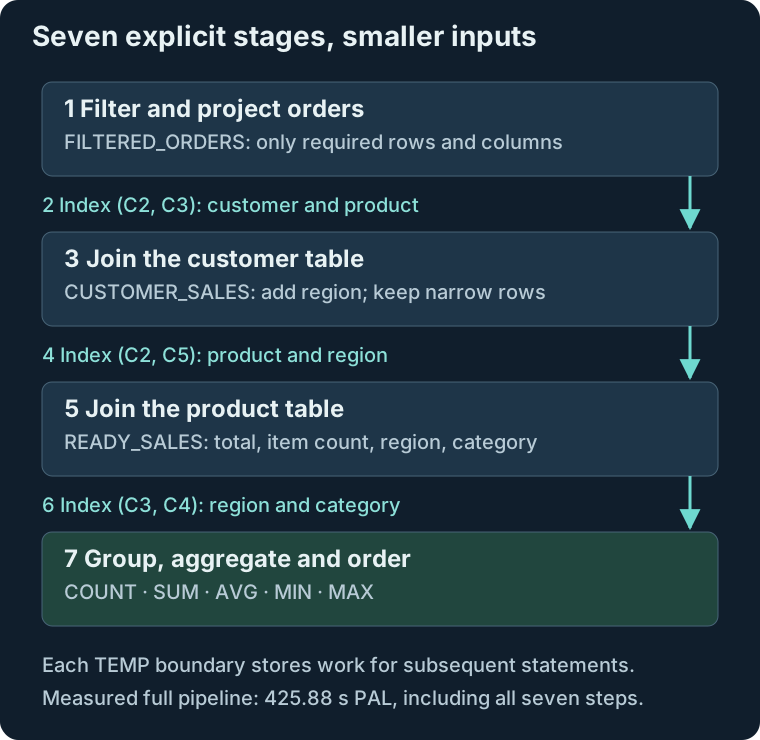
CTAS creates a real intermediate table. Later statements query that table instead of repeating the whole earlier relationship walk.
CREATE [TEMP] TABLE name AS SELECT ... derives C1-C8 columns from the result
cursor and supports fixed, aggregate, raw TEXT/BLOB, substring, and concatenation
projections across ordinary, correlated, joined, and direct three-source producers. The
destination remains hidden under a persistent BUILDING marker while rows and variable
payload pages commit in bounded transactions; clearing that marker publishes the
complete result atomically. Variable values receive independent handles.
A reported failure or the next initialization reclaims an unfinished build, including results larger than the sixteen-page journal.
TEMP lifecycle and DROP
Session cleanup
TEMP tables have session lifecycle rather than merely a catalog label.
rsql_shutdown() marks them invisible and reclaims their indexes, rows, and variable
payloads; rsql_init() resumes cleanup interrupted after that visibility transition.
Persistent tables are unaffected.
DROP TABLE
DROP TABLE name applies the same lifecycle to a persistent or TEMP table. The first
transaction commits the DROPPING visibility marker; a failure before that write leaves
the table visible, while an interruption afterward leaves it invisible and
initialization completes reclamation. A missing name returns RSQL_ERR_NOT_FOUND.
DROP INDEX
DROP INDEX name first marks the named index invisible, then advances and frees its
leaf chain before unlinking the descriptor. A marked index is ignored by explicit USING INDEX binding and DML rebuilds; initialization resumes an interruption. The indexed
table and its rows are not changed.
DROP TYPE
DROP TYPE name supports ENUM8/ENUM16 catalog types. It is restricted: if any visible
table column still carries that enum catalog ID, the statement returns
RSQL_ERR_DEPENDENT_OBJECT. Otherwise it marks the type invisible, reclaims member
pages one at a time, and unlinks the descriptor; initialization resumes a marked type.
Enum IDs remain monotonic and are not reused. IF EXISTS and CASCADE are not
implemented.